
The River Still Flows
A Story from Ndibe

In the village of Ndibe the river curved through the land the way a python rests after feeding, slow and heavy with memory. The people there measured time by the farming seasons and the festivals that marked them. When the first rains softened the earth, men cleared their yam mounds. When the new yams were ready, the whole village gathered to thank the earth and the ancestors who still walked among them in the dust of evening. Kola nuts were broken before every important conversation. The white chalk of peace was drawn on the ground when disputes threatened to harden into something worse. Children learned early that a person who could not speak in proverbs had not yet grown into full speech.
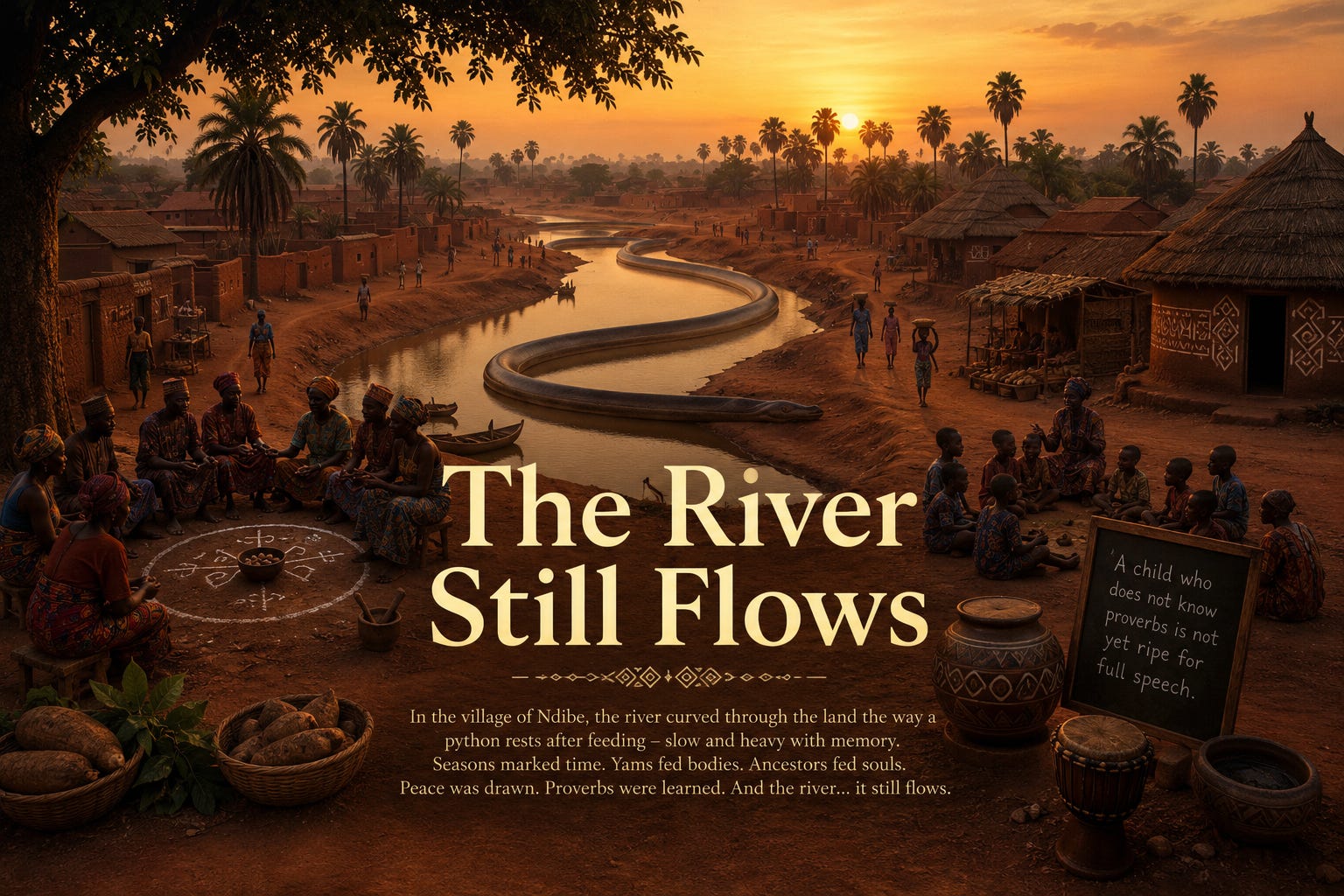
Nneka was the head of the women’s council that year. She had earned the position not through inheritance but through the quiet authority that comes from surviving what others could not. Three of her children had died before they were old enough to receive names. She had continued to farm her late husband’s land, refused to remarry when the lineage pressed her, and settled more market quarrels than most men settled under the big iroko tree. When she spoke, even the titled elders usually listened, though some pretended they were only being polite.
Her daughter Adanna was seventeen and already known for a sharp mind. She could keep the accounts of the women’s cloth trade in her head and recite the names of every family that owed or was owed. She asked questions that made older people uncomfortable. Why must a widow wait for the lineage to decide her future? Why were certain children still left in the forest if they came in pairs? Why did the ancestors need fresh blood on the shrine when the harvest had already been good? Nneka answered some of these questions with patience and others with silence. She believed that not every door should be opened simply because a young hand could reach the latch.
Life in Ndibe moved according to its old patterns. The market opened every fourth day. Women arrived early with their loads of pepper, smoked fish, and cloth. Men gathered under the iroko to discuss land and titles. In the evenings the younger age grades practiced their dances for the coming festivals. Adanna took part in these things, yet something in her remained restless. She listened closely when traders from the river towns passed through, men who spoke of distant places and strange new goods. She watched the horizon more than most girls her age. Nneka noticed but said little. A mother learns which questions will answer themselves with time and which ones will not.
It was during the third month of the dry season, when the earth had grown hard and the air carried the first fine dust of harmattan, that three men appeared on the path that led from the larger river towns. They were not traders. One carried a book bound in dark leather. Another carried tools for measuring distance. The third spoke a little of the local language and explained that they had come from the coast with the permission of a distant authority. They asked only to stay for a short time on a piece of unused land beyond the sacred grove.
The elders met for two days. Some said the men should be sent away before they brought trouble. Others said hospitality was required by custom and that strangers who came peacefully had always been given water and a place to rest. In the end a small clearing far from the ancestral shrines was granted. No one expected the visitors to remain once the rains returned.
They built a rectangular house with a roof of metal that rang loudly when the first rain finally came. At first only a few restless young men went to see what was taught there. Then two young women. Then Adanna, who went once out of curiosity and returned with her eyes bright and her mouth full of new words. She spoke of a single god who required no annual sacrifice and of a law that treated every person the same regardless of title or lineage. Nneka listened while she ground pepper on the stone. She did not forbid her daughter. She only said that a bird that learns the song of another forest may forget the way back to its own nest.
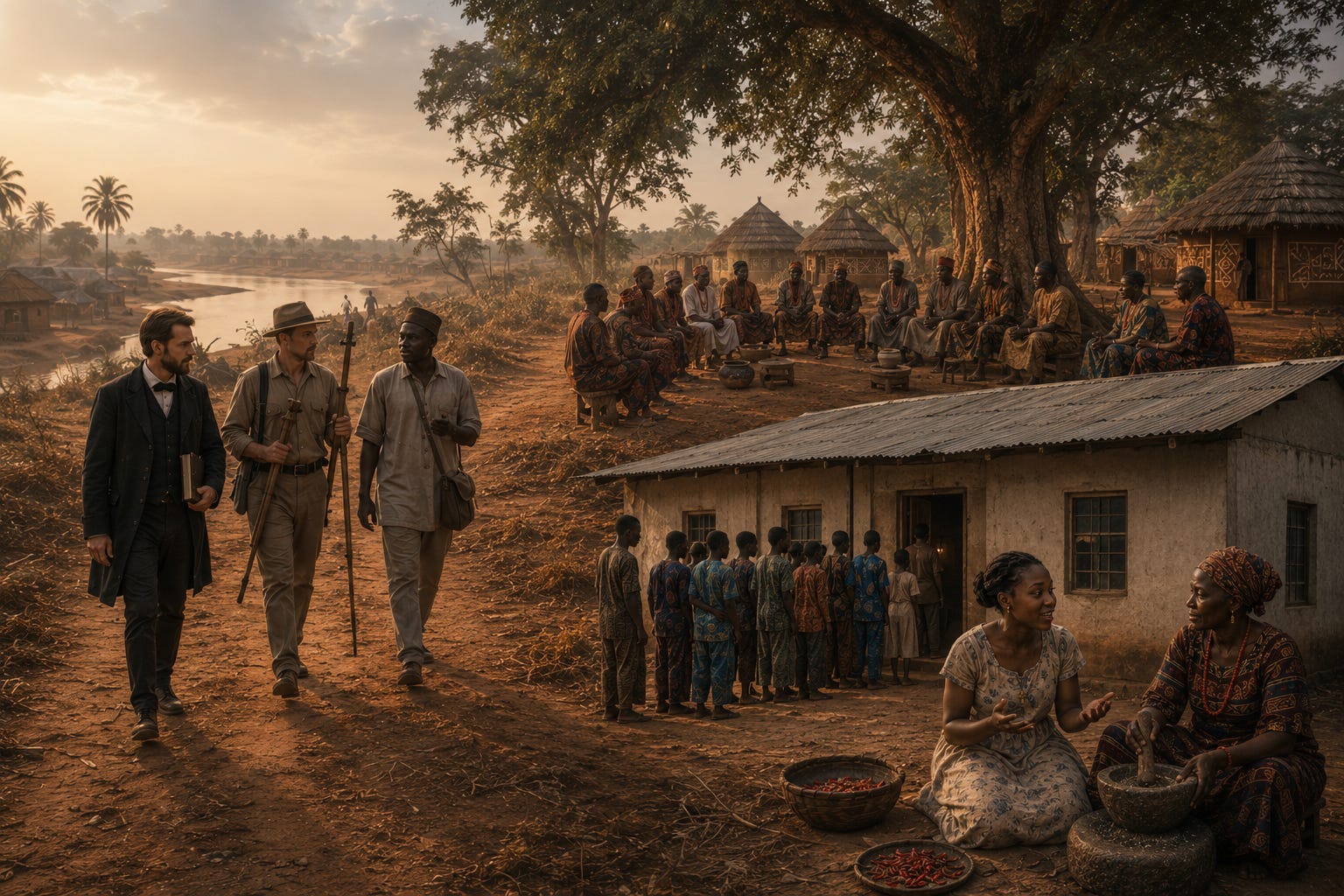
Months passed. The rectangular house became a place of regular gathering. Some families began to stay away from the festival of the river spirit. A young man of the age grade refused the scarification marks that would have completed his passage into full adulthood. Arguments that once ended with shared palm wine now ended with people walking away in different directions. The women’s council felt the strain. Two of Nneka’s closest companions stopped attending the meetings. They said the old ways of settling disputes were too slow and that the strangers offered clearer judgments.
The real trouble began with the death of Okorie, a man of high title who had held the ofo of his lineage for twenty years. His funeral required the full rites: the washing of the body by the daughters of the lineage, the firing of guns if the family could afford them, the appearance of the masked ancestral spirits who would dance the final farewell, and the second burial months later when the spirit was believed to have settled among the ancestors. Okorie’s eldest son, Obinna, was responsible for seeing that everything was done correctly. He was a careful man, respectful of custom, but he had also begun to visit the strangers’ house in the evenings. Some said he went only to learn how to write the names of his father’s properties so that no one could cheat the family later. Others said he had started to doubt the necessity of the masked spirits.
When the time came for the masked ancestors to appear, two of the carvers refused to participate. They had joined the new gathering and said they would no longer put on the masks of spirits they no longer fully believed in. The ceremony could not proceed without them. Obinna delayed the rites. The lineage grew restless. Older men muttered that a spirit left unburied properly could trouble the living for generations. Nneka, whose council had always helped prepare the food and the mourning cloths, went to Obinna’s compound and spoke plainly.
“The dead do not wait forever,” she said. “And the living cannot eat if the ground between them is full of unresolved matters. Find another way that still honors what must be honored.”
Obinna answered that the world was changing and that perhaps some of the old requirements could be adjusted. Nneka left without raising her voice, but the women who walked with her that evening said her silence was heavier than any argument.
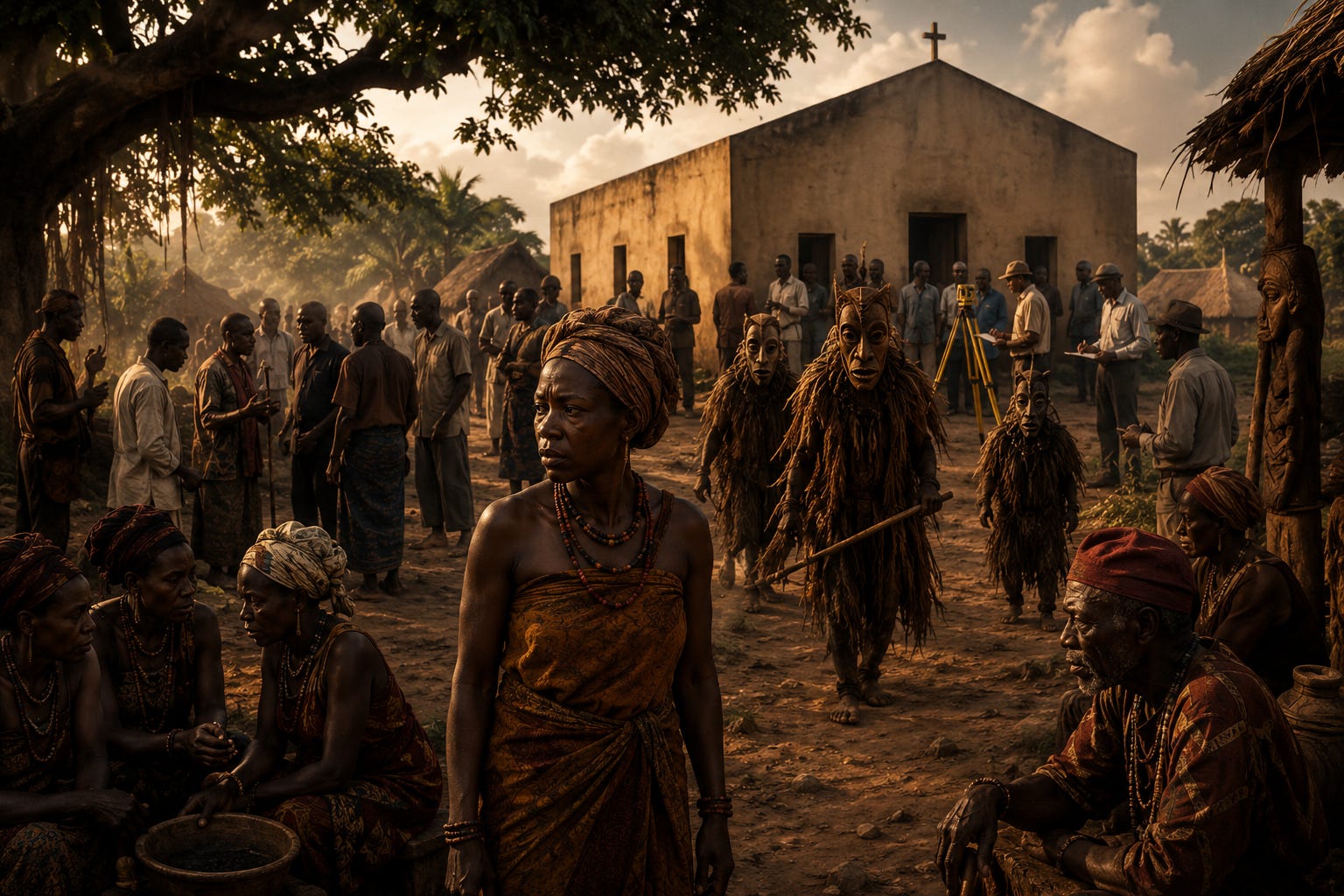
The strangers’ presence grew more visible. Surveyors appeared with chains and notebooks and began measuring paths that had never needed measurement. They asked questions about who owned which piece of farmland and wrote the answers in their book as if writing could settle what the ancestors had already decided. Some villagers cooperated, hoping the new authority would protect their claims. Others refused to speak. The market itself began to change. New weights appeared. Coins replaced some of the old barter. The women’s council found itself settling disputes that involved rules no one had agreed to.
One evening the sacred grove was found disturbed. Several of the older shrine figures had been moved or broken. No one admitted responsibility. Accusations flew between those who followed the new teaching and those who kept the old observances. The elders called a meeting under the iroko. Voices rose. A few men reached for the staffs they carried as signs of title. Nneka stood and waited until the noise lessened.
“If we tear ourselves apart over who broke the figures,” she said, “the figures will not be the only things that remain broken. The river still flows. The yams still need tending. The children still need to be taught how to speak to their own people. Decide what must be repaired first.”
Her words calmed the moment but did not heal the division. In the following weeks more families drifted toward the rectangular house. Others withdrew further into the old practices, holding smaller, quieter ceremonies in private compounds. Adanna spent most of her days at the new school. When she came home she and her mother spoke carefully, as if stepping around something fragile on the floor.
The second burial of Okorie was finally performed in a reduced form. Only one mask appeared. The crowd was smaller than custom required. Some of the necessary songs were sung by fewer voices. Afterward people left quickly. The air felt unfinished.
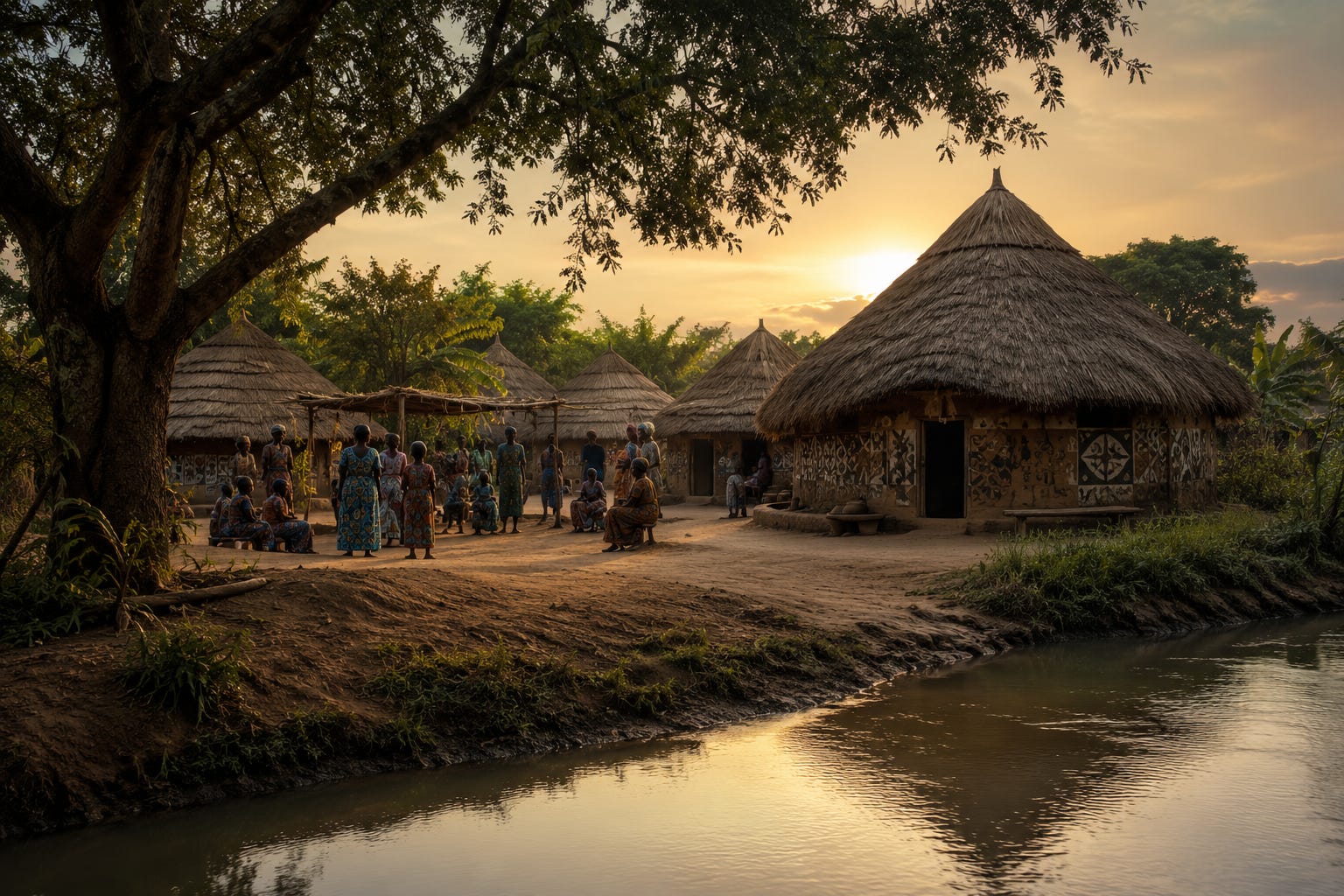
Nneka continued her work in the market and in the council. She settled what quarrels she could. She broke kola with those who still came to her. She watched the path that led toward the strangers’ house and the path that led toward the sacred grove and saw that fewer people walked both.
One morning the soldiers came with an order written in the strangers’ language. They required the presence of several elders and the head of the women’s council at the new court building that had been raised near the edge of the grove. Nneka went. She wore her simplest wrapper and carried nothing but the small bag in which she kept white chalk and a piece of kola. Adanna stood among the people who watched her leave. Neither mother nor daughter spoke.
What followed was never agreed upon.
Some said Nneka answered every question put to her with the same calm she had always shown in the market and that the officers found no reason to hold her. Others said she refused to acknowledge the authority of the written order and was kept for several days before being released far from Ndibe. A few claimed she walked away from the court building when no one was watching and followed the river until the village could no longer see her. One elderly woman insisted she had met Nneka years later in a distant market town, selling pepper and speaking little of the past. Another said the river had taken her, as it sometimes took those who carried too many unresolved matters.
The village continued. The market still opened every fourth day. The river still curved through the land. Children still learned proverbs, though fewer of them learned the full meaning behind the older ones. The rectangular house grew larger. The sacred grove grew quieter. Adanna eventually left for further schooling and returned only for brief visits, each time carrying more of the new world with her and leaving a little more of the old one behind.
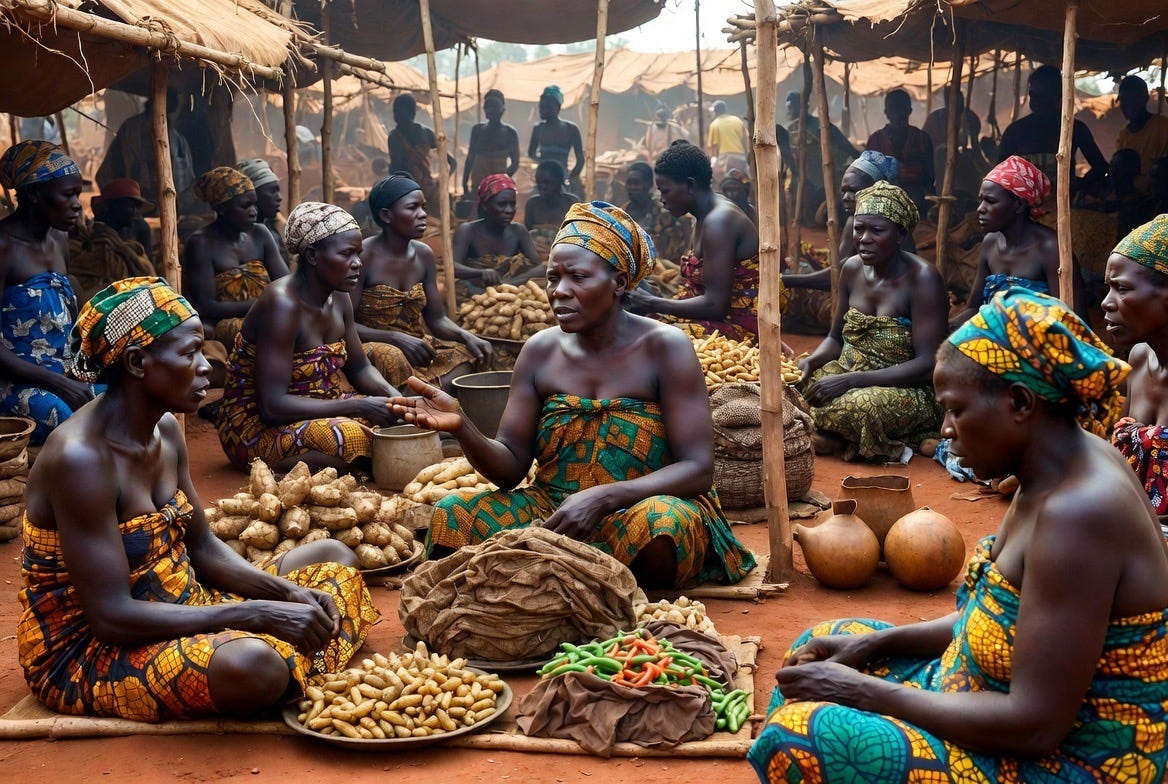
In the harmattan season, when the wind brought fine dust from the north and the air turned the color of dried blood, the older women sometimes gathered near the place where Nneka’s market stall had stood. They spoke of her in low voices. They disagreed about where she had gone and what her final silence had meant. No single story satisfied everyone. The current had moved, and those who remained learned to swim in water that no longer tasted entirely of home.
Stories like this fill me with nostalgia for the past a time when African culture was still in its original form, untouched and undiluted.
If I had lived in that era, I probably would've been killed because I'd have stood against many of the rituals they practised. Then again... who knows? Maybe I wouldn't have stood up at all.
I wish we'd found a balance between preserving our culture and letting go of practices that caused harm. But I'll know better once I finish Arrow of God by Chinua Achebe 😅😊.
I really enjoyed the read.
We need a book now😜 Does the Queen reply??